Digital Marketing in India: Strategies, Benefits and the Future of Online Business
Digital marketing in India has evolved from being an additional marketing channel into an important part of business strategy.
Whether you operate a local business, startup, professional service company, e-commerce store, or established enterprise, digital marketing can help you increase visibility, attract targeted customers, generate leads, and build a stronger online presence.
The most effective approach is not to use every digital channel simply because it exists. Instead, businesses should identify their ideal customers, understand where those customers spend time online, select the right marketing channels, measure results, and continuously improve their strategy.
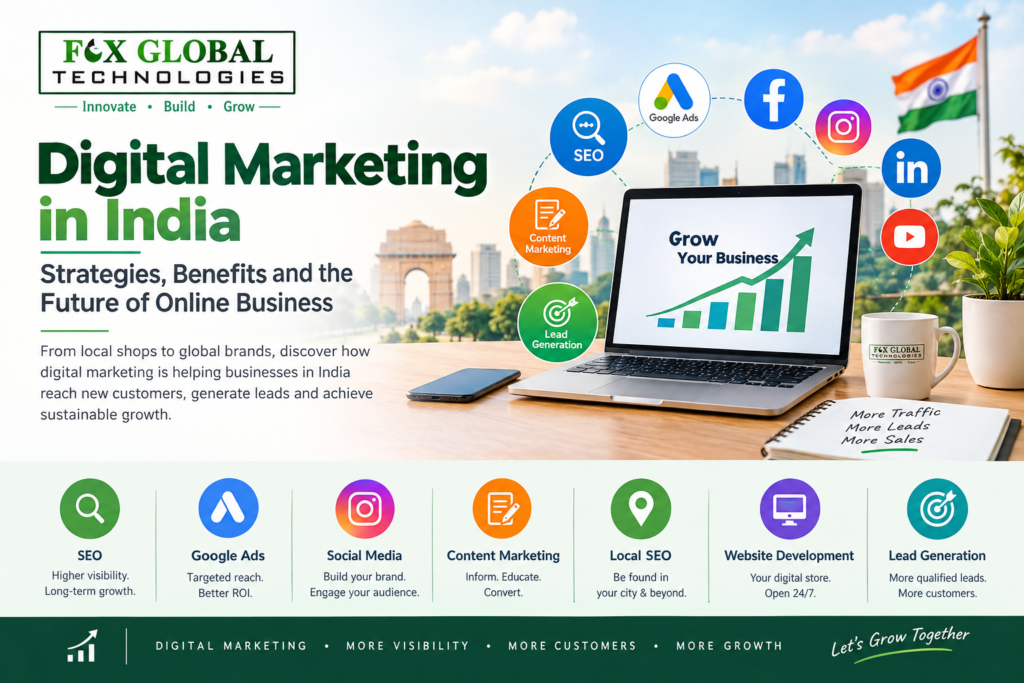
India has experienced a remarkable transformation in the way businesses connect with customers. From local shops and startups to established enterprises and global companies, businesses are increasingly using digital channels to reach their target audiences. This transformation has made **digital marketing in India** an essential part of modern business growth.
With consumers spending more time online, having a strong digital presence is no longer optional. Businesses need to be visible where their customers are searching, browsing, comparing products, and making purchasing decisions.
## What Is Digital Marketing?
Digital marketing refers to promoting products, services, and brands through online channels and digital technologies. Unlike traditional marketing methods such as newspapers, television, and outdoor advertising, digital marketing allows businesses to communicate with specific audiences and measure campaign performance.
Common digital marketing services include:
– Search Engine Optimization (SEO)
– Google Ads and Pay-Per-Click (PPC) advertising
– Social media marketing
– Content marketing
– Local SEO
– Email marketing
– Online reputation management
– Lead generation
– Website development and optimization
– Conversion rate optimization
– Video marketing
These strategies can be used individually or combined into a complete digital marketing campaign.
## Why Is Digital Marketing Important in India?
India has a diverse and rapidly growing digital consumer market. Customers increasingly use search engines, social media platforms, websites, maps, and online marketplaces to research businesses before making decisions.
For businesses, this creates an enormous opportunity.
A small business in Kolkata can attract customers beyond its local neighborhood. An Indian service provider can generate leads from other cities. A company can also target international customers without opening physical offices in every market.
Digital marketing therefore provides businesses with the ability to expand their reach while maintaining greater control over their marketing budgets.
## Search Engine Optimization: Building Long-Term Visibility
SEO is one of the most important components of digital marketing in India.
When potential customers search for products or services online, businesses want their websites to appear prominently in search results. SEO helps improve a website’s visibility for relevant search queries.
An effective SEO strategy may include:
– Keyword research
– Technical SEO
– On-page optimization
– Content creation
– Local SEO
– Website speed optimization
– Internal linking
– Link building
– Google Business Profile optimization
– Competitor research
For example, a local business might target searches such as **”digital marketing agency in Kolkata,” “SEO services in India,”** or other location- and service-specific keywords.
Unlike paid advertising, SEO can continue generating organic traffic after the initial work has been completed, although it requires ongoing optimization and quality content.
## Google Ads and Paid Advertising
SEO takes time to produce sustainable results, while paid advertising can help businesses reach potential customers more quickly.
Google Ads allows businesses to advertise when users search for relevant products and services. Campaigns can be designed around specific keywords, locations, audiences, devices, and business objectives.
For example, a business selling professional services can create campaigns targeting people actively searching for those services.
However, successful advertising requires more than simply increasing the budget. Businesses need to focus on:
– Relevant keywords
– Strong ad copy
– High-quality landing pages
– Appropriate targeting
– Conversion tracking
– Negative keywords
– Cost-per-lead management
– Continuous campaign optimization
The objective should be generating **qualified leads and measurable business results**, rather than simply increasing website traffic.
## Social Media Marketing in India
Social media has become an important communication channel for Indian businesses.
Platforms such as Instagram, Facebook, LinkedIn, and YouTube allow brands to interact directly with potential customers and existing clients.
Social media marketing can be used for:
– Brand awareness
– Product promotion
– Educational content
– Customer engagement
– Lead generation
– Community building
– Retargeting
– Reputation management
The most effective social media strategy is not simply posting promotional content every day. Businesses should create useful and engaging content that gives customers a reason to follow and interact with the brand.
## Local SEO for Indian Businesses
Local SEO is particularly important for businesses that serve customers in specific cities or regions.
A properly optimized Google Business Profile can help a business appear when nearby customers search for relevant products or services.
Local SEO activities may include:
– Google Business Profile optimization
– Local keyword targeting
– Business directory optimization
– Customer review management
– Location-specific website pages
– Local content
– Accurate business information
For example, a Kolkata-based clinic, restaurant, law firm, retailer, or marketing agency can use local SEO to improve visibility among customers searching for businesses in Kolkata.
## Content Marketing: Giving Customers Useful Information
Content is at the heart of modern digital marketing.
Customers often search for information before contacting a company. A well-written blog can answer their questions, demonstrate expertise, and introduce them to a company’s products or services.
Content marketing can include:
– Blog articles
– Guides
– Case studies
– Videos
– Infographics
– FAQs
– Social media content
– Industry reports
– Landing pages
For example, a website development company could publish articles about website security, mobile app development, e-commerce websites, and business automation.
This type of content can attract people who are researching a problem before they are ready to purchase.
## Lead Generation Through Digital Marketing
For many businesses, the ultimate goal of digital marketing is generating qualified leads.
Lead generation involves attracting potential customers and encouraging them to take an action such as:
– Calling the business
– Filling out a contact form
– Sending a WhatsApp message
– Requesting a quotation
– Booking a consultation
– Signing up for a service
A strong lead-generation campaign connects multiple elements, including advertising, SEO, landing pages, compelling content, conversion tracking, and follow-up systems.
Generating 1,000 visitors is not necessarily valuable if none of them become customers. The real objective is to generate the right visitors and convert them into genuine business opportunities.
## Website: The Foundation of Your Digital Presence
A company’s website is often the central point of its digital marketing strategy.
Advertising and social media may bring visitors to the business, but the website must convince those visitors to take the next step.
A professional business website should generally have:
– Clear navigation
– Mobile-friendly design
– Fast loading speed
– Strong calls to action
– Relevant and original content
– Secure hosting
– Search-friendly structure
– Contact options
– Trust signals
– Clear service or product information
A website should not only look attractive. It should also be designed around the customer journey and business objectives.
## Digital Marketing for Small Businesses in India
Digital marketing is not limited to large corporations.
Small businesses can compete effectively by focusing on specific audiences, locations, and services.
Instead of attempting to reach everyone, a small business can target a clearly defined customer segment.
For example:
**A local retailer:** Local SEO + Google Business Profile + social media
**A B2B company:** SEO + LinkedIn + content marketing + lead generation
**An e-commerce business:** SEO + Google Ads + social media + remarketing
**A professional service provider:** Local SEO + Google Ads + landing pages + reviews
The right strategy depends on the business model, target audience, competition, and available marketing budget.
## Measuring Digital Marketing Performance
One of the biggest advantages of digital marketing is measurability.
Businesses can track metrics such as:
– Website traffic
– Search rankings
– Leads
– Calls
– Form submissions
– Conversion rates
– Cost per lead
– Return on advertising spend
– Customer acquisition cost
– Engagement
– Revenue generated
These metrics help businesses understand which campaigns are working and where improvements are required.
Marketing decisions should increasingly be based on data rather than assumptions.
## Challenges of Digital Marketing in India
Although digital marketing provides enormous opportunities, it also comes with challenges.
Competition is increasing across almost every industry. Search rankings can change, advertising costs can fluctuate, consumer behavior evolves, and social media algorithms continue to change.
Businesses also need to be careful about low-quality content, unrealistic promises, poor lead quality, and ineffective advertising campaigns.
A successful digital marketing strategy therefore requires consistency, testing, analysis, and continuous improvement.
## The Future of Digital Marketing in India
The future of digital marketing in India is likely to become increasingly data-driven and personalized.
Artificial intelligence, automation, conversational technologies, advanced analytics, short-form video, voice-based search, and personalized customer experiences are changing how businesses communicate with audiences.
However, technology alone will not guarantee success.
Businesses will still need strong brands, useful content, trustworthy communication, excellent customer service, and a clear understanding of their customers.
The companies that combine technology with genuine customer value will have a stronger opportunity to build long-term digital growth.
