
Merchant Cash Advance Lead Generation in the USA: A Complete Guide
Merchant cash advance lead generation in the USA requires much more than running advertisements or purchasing contact lists.
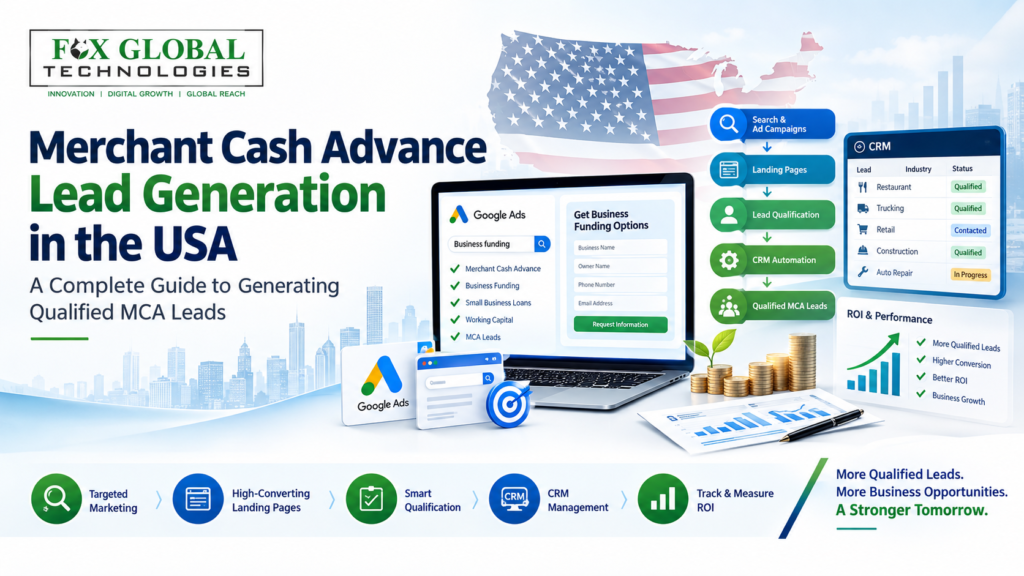
A successful strategy combines Google Ads, SEO, high-converting landing pages, industry-specific targeting, lead qualification, CRM automation, fast follow-up, analytics, and compliance.
For MCA brokers, ISOs, funders, and financial marketing companies, the objective should be clear: attract legitimate business owners who are actively interested in exploring funding, provide them with accurate information, and build a measurable process that converts qualified inquiries into sustainable business opportunities.
With the right strategy, technology, and optimization process, MCA lead generation can become a scalable customer-acquisition channel for businesses operating in the U.S. alternative-financing market.
Merchant Cash Advance (MCA) has become an important alternative funding option for many small businesses in the United States. Restaurants, retail stores, construction companies, auto repair shops, trucking businesses, salons, healthcare practices, contractors, and e-commerce businesses may need working capital to manage cash flow, purchase inventory, cover operating expenses, or expand their businesses.
For MCA brokers, ISOs, funders, and financial marketing companies, the challenge is not simply finding business owners. The real challenge is finding high-intent, qualified MCA leads that have a genuine interest in business funding.
This is where a well-planned merchant cash advance lead generation strategy can make a significant difference.
What Is Merchant Cash Advance Lead Generation?
Merchant cash advance lead generation is the process of attracting business owners who may be interested in obtaining working capital or alternative business financing.
Instead of contacting large lists of unrelated businesses, a targeted MCA lead generation campaign focuses on business owners who are actively searching for funding or are likely to have a current financing requirement.
A qualified MCA lead may include information such as:
Business name
Business owner’s name
Phone number
Email address
Business location
Industry
Time in business
Estimated monthly revenue
Desired funding amount
Intended use of funds
Current financing requirements
The more accurately a lead matches a funder’s target profile, the more useful it can be for the sales team.
Why MCA Lead Generation Is Important in the USA
Small businesses frequently experience cash-flow challenges. A company may have strong sales but still require additional working capital because customers pay invoices later, inventory costs increase, equipment needs replacement, or the business wants to expand.
MCA and other alternative financing products can provide another option for businesses that may not fit traditional bank-financing criteria.
For MCA companies, however, competition for qualified merchants can be significant. This makes digital marketing, lead qualification, fast follow-up, and accurate targeting essential parts of the acquisition process.
The Best Channels for MCA Lead Generation
A successful MCA marketing campaign normally combines multiple acquisition channels rather than relying on one source.
1. Google Ads for MCA Leads
Google Search Ads can be particularly valuable because they allow marketers to reach people who are actively searching for business funding.
Potential keyword themes include:
Merchant cash advance
MCA funding
Business funding
Business cash advance
Small business funding
Working capital for business
Fast business funding
Business financing
Same-day business funding
Alternative business financing
Search campaigns should be organized into tightly focused ad groups. Separate campaigns can also be created for different industries or funding requirements.
For example:
Restaurant Funding
Target restaurants searching for working capital, inventory funding, equipment purchases, or business expansion.
Trucking Business Funding
Target trucking companies looking for capital for repairs, fuel, expansion, or operational expenses.
Construction Business Funding
Target contractors and construction companies searching for working capital to manage projects, payroll, materials, or equipment.
The objective should not simply be generating the maximum number of clicks. The objective is generating relevant business funding inquiries.
2. High-Converting MCA Landing Pages
Sending paid advertising traffic to a generic homepage can reduce conversion opportunities.
A dedicated MCA landing page should clearly communicate:
What type of financing is being offered
Who the financing may be suitable for
Basic qualification criteria
How the application process works
What information may be required
How the business owner can request more information
Important terms and disclosures
A strong landing page should also have a clear call-to-action such as:
“Explore Your Business Funding Options”
or
“Request a Business Funding Review”
The form should collect enough information to help qualify the prospect without making the application unnecessarily complicated.
3. SEO for MCA Lead Generation
Search engine optimization can help create a long-term source of organic traffic.
An MCA website can build content around topics such as:
Merchant cash advance
Merchant cash advance requirements
MCA funding
Business cash advance
Small business working capital
Fast business funding
Business funding for restaurants
Business funding for trucking companies
Business funding for construction companies
Business financing for bad credit
Alternative business financing
How merchant cash advance works
Instead of publishing generic articles, create useful content that answers the questions business owners are actually searching for.
For example:
What Is a Merchant Cash Advance?
Explain how the product works, who it may be suitable for, and what businesses should consider before applying.
How Much Business Funding Can I Qualify For?
Explain that funding decisions depend on factors such as business revenue, cash flow, business history, underwriting criteria, and the specific provider.
MCA vs. Traditional Business Financing
Explain the differences between alternative financing and traditional financing so business owners can make informed decisions.
This approach can help build search visibility while establishing credibility.
4. Local SEO for MCA Lead Generation
Local SEO can also be useful when targeting specific U.S. markets.
Landing pages can be developed around locations such as:
Business Funding in New York
Business Funding in Texas
Business Funding in Florida
Business Funding in California
Business Funding in New Jersey
Business Funding in Georgia
Business Funding in Illinois
However, location pages should provide genuinely useful information rather than simply repeating the same content with different city names.
5. Social Media Marketing
Social media can support MCA lead generation by creating awareness among business owners.
Platforms such as Facebook, Instagram, LinkedIn, and other business-focused channels can be used for:
Educational content
Business funding tips
Industry-specific financing information
Customer education
Business growth content
Lead-generation campaigns
For example, a campaign could focus specifically on restaurant owners:
“Need working capital for inventory, equipment, staffing, or expansion? Explore available business funding options.”
The message should be informative and accurate rather than relying on unrealistic promises.
6. Email Marketing and Lead Nurturing
Not every prospect is ready to move forward immediately.
Some business owners may submit an inquiry but require additional time before making a financing decision.
An effective lead-nurturing strategy can include educational emails covering:
Business funding options
Working capital management
Preparing financial documents
Understanding funding costs
Improving business cash flow
Funding requirements
Common application mistakes
This allows businesses to maintain communication with prospects without relying entirely on immediate conversions.
7. Real-Time MCA Lead Delivery
Speed can be an important part of lead management.
When a business owner submits an inquiry, the lead can be automatically routed to the appropriate sales representative through:
CRM integrations
Webhooks
APIs
Email notifications
Lead-routing platforms
Automated qualification systems
A typical workflow can look like:
Google Ads → Landing Page → Application Form → Lead Validation → CRM → Sales Team → Follow-Up → Underwriting → Funding
The goal is to minimize unnecessary delays and ensure that every legitimate inquiry is handled efficiently.
What Makes a High-Quality MCA Lead?
Lead quantity alone does not determine campaign success.
A high-quality MCA lead should ideally be:
Relevant
The prospect should match the business’s target customer profile.
Fresh
Recently submitted leads generally provide a better opportunity for timely follow-up.
Accurate
Contact information should be valid and usable.
Qualified
The lead should meet the campaign’s basic eligibility criteria.
Intent-Based
The prospect should demonstrate an actual interest in exploring business funding.
Properly Consented
Lead-generation systems should clearly explain how submitted information will be used and shared where applicable.
Exclusive vs. Shared MCA Leads
MCA leads can generally be categorized as exclusive or shared.
Exclusive Leads
An exclusive lead is provided to one buyer.
The potential advantage is reduced competition for the same prospect.
Shared Leads
A shared lead may be provided to multiple companies.
These leads can sometimes cost less, but the sales team may compete with other providers contacting the same prospect.
When purchasing leads, businesses should understand:
Lead source
Exclusivity
Lead age
Qualification criteria
Information provided
Replacement/refund policy
Consent process
Number of buyers receiving the lead
Lead Qualification: The Key to Better Conversion
Lead qualification is one of the most important components of MCA marketing.
A qualification form may ask questions such as:
How long has the business been operating?
What industry is the business in?
What is the approximate monthly revenue?
How much funding is being considered?
What will the funding be used for?
What state is the business located in?
These questions can help the sales team prioritize opportunities and determine whether a prospect fits the campaign’s target profile.
CRM and Automated Lead Management
A CRM system can help MCA companies manage leads from the first inquiry through the sales process.
Important CRM fields can include:
Lead source
Campaign
Keyword
Industry
State
Revenue range
Funding amount
Lead status
Sales representative
Follow-up date
Application status
Funding outcome
This creates a complete view of the marketing funnel.
For example:
Lead → Contacted → Qualified → Application → Underwriting → Approved → Funded
Tracking these stages helps determine which marketing channels generate actual business results rather than simply generating inexpensive leads.
Tracking the ROI of MCA Marketing
A successful MCA campaign should be measured beyond cost per lead.
Important metrics include:
Click-through rate
Landing-page conversion rate
Cost per lead
Qualified lead rate
Contact rate
Application rate
Approval rate
Funding rate
Cost per funded deal
Revenue generated
Return on advertising spend
For example, a campaign generating 100 inexpensive leads may appear successful. But if only two become qualified opportunities, it may perform worse than a campaign generating 30 highly relevant leads.
The ultimate objective is profitable customer acquisition, not simply lead volume.
Compliance and Responsible MCA Marketing
Compliance is a critical part of financial marketing.
The Federal Trade Commission states that businesses involved in small-business financing, including lenders, finance providers, marketers, ISOs, brokers, and lead generators, can fall within the FTC Act’s protections against deceptive and unfair practices. The FTC has also emphasized that companies can remain responsible for the conduct of marketing intermediaries they use.
Therefore, MCA advertising should avoid misleading statements about:
Guaranteed approval
Guaranteed funding
Funding amounts
Costs
Payment obligations
Eligibility
Government affiliation
Product characteristics
Marketing claims should accurately reflect the actual financing product and its requirements.
Lead-generation businesses should also pay close attention to how consumer or business-owner information is collected, disclosed, routed, and used. The CFPB has specifically discussed the risks associated with digital lead generators steering applicants toward particular financial providers based on compensation.
Because financial-services rules can vary by product, state, business model, and customer type, MCA companies should obtain appropriate legal and compliance advice before launching campaigns.
How to Build a Complete MCA Lead Generation Funnel
A professional MCA marketing funnel can be structured as follows:
Step 1: Define the Target Audience
Identify the industries, states, revenue profiles, and funding requirements you want to target.
Step 2: Research Search Intent
Identify the keywords and questions potential customers use when looking for business financing.
Step 3: Launch Search Campaigns
Create targeted Google Ads campaigns around high-intent funding searches.
Step 4: Build Dedicated Landing Pages
Create landing pages designed specifically around each campaign and audience.
Step 5: Qualify the Lead
Collect relevant information through a structured form.
Step 6: Validate the Information
Verify contact information and apply appropriate qualification rules.
Step 7: Send the Lead to the CRM
Automatically route qualified leads to the appropriate sales team.
Step 8: Follow Up Quickly
Contact legitimate prospects promptly and professionally.
Step 9: Track the Sales Funnel
Measure every stage from lead generation through application and funding.
Step 10: Optimize Campaigns
Increase investment in campaigns, keywords, industries, and locations that generate profitable results.
Why Industry-Specific MCA Marketing Can Work
Different industries have different financial challenges.
For example:
Restaurants: inventory, payroll, equipment, renovation and expansion.
Trucking: fuel, vehicle repairs, maintenance and fleet expansion.
Construction: materials, payroll, project expenses and equipment.
Auto Repair: equipment, inventory and operational expenses.
Retail: inventory purchasing, seasonal demand and expansion.
Salons and Beauty Businesses: renovation, equipment, staffing and expansion.
Creating marketing campaigns around these specific business needs can make the message more relevant than generic “business funding” advertising.
The Future of MCA Lead Generation in the USA
The MCA marketing industry is becoming increasingly data-driven.
Modern lead-generation systems can combine:
Search advertising
SEO
Landing pages
CRM automation
Lead scoring
Conversion tracking
API integrations
Automated lead routing
Data analytics
Retargeting
AI-assisted marketing workflows
The companies that combine these technologies with strong qualification and responsible marketing can build more predictable acquisition systems.
The focus is gradually moving from simply purchasing large quantities of leads toward generating better-targeted, transparent, measurable, and higher-intent opportunities.
