
Digital Marketing: How Businesses Can Grow, Connect with Customers, and Build a Strong Online Presence
Digital marketing has become an essential part of modern business growth. It gives businesses the opportunity to reach new customers, improve brand visibility, generate leads, increase sales, and build long-term customer relationships.
However, successful digital marketing is not about using every available platform or spending money on advertisements without a clear plan. It is about choosing the right strategy, communicating the right message, and reaching the right audience at the right time.
Whether you run a small local business, a startup, or an established company, investing in a well-planned digital marketing strategy can help you compete in an increasingly connected marketplace.
At the end of the day, people do not simply buy products or services. They choose businesses they recognize, understand, and trust. That is what meaningful digital marketing is really about.
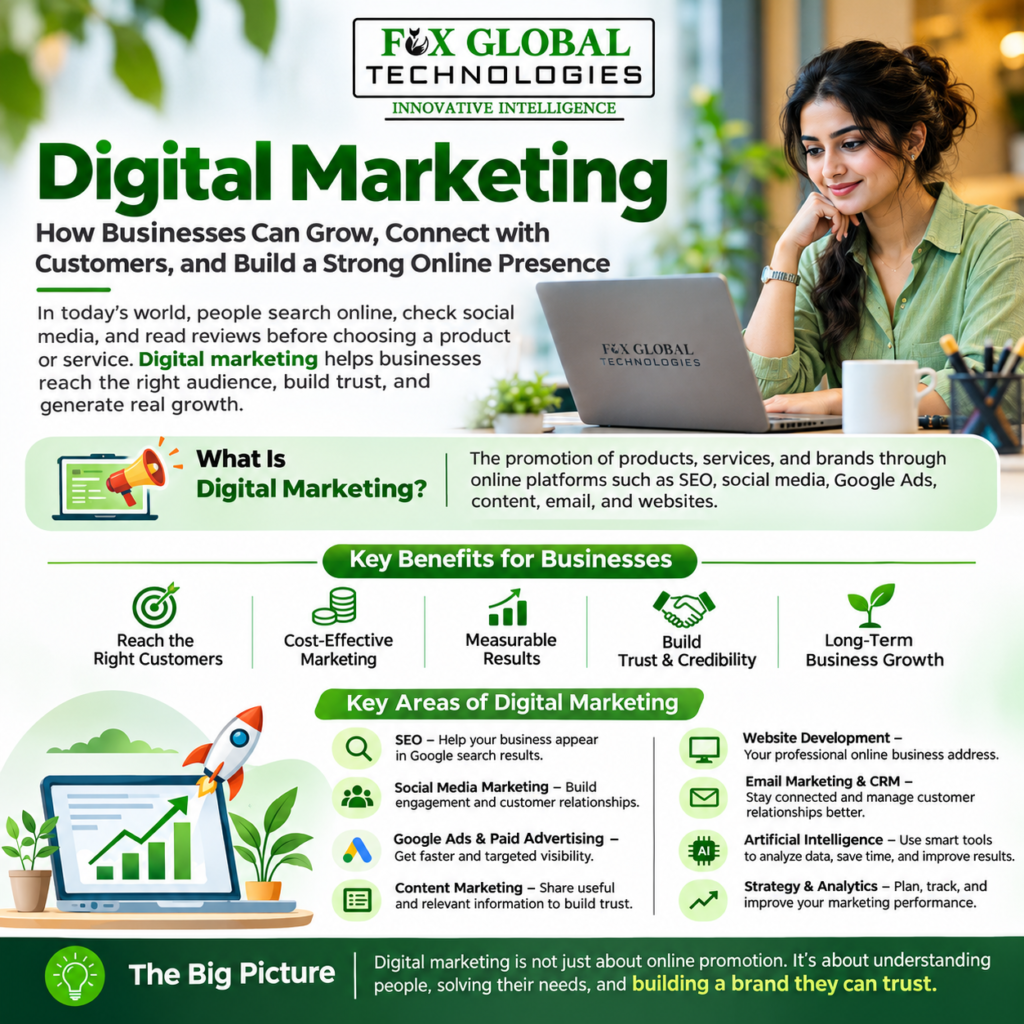
In today’s world, almost everyone uses the internet in some way. People search Google before purchasing a product, check social media before visiting a store, and read online reviews before choosing a service provider. The way customers discover and interact with businesses has changed significantly. This is where digital marketing plays an important role.
Digital marketing is no longer limited to large companies with big advertising budgets. Small businesses, startups, local shops, service providers, and established brands can all use digital platforms to reach their target audiences. It gives businesses an opportunity to tell their stories, showcase their products and services, build customer relationships, and generate sales.
At its heart, digital marketing is not just about selling something online. It is about understanding people, identifying their needs, and communicating with them through the right channels.
What Is Digital Marketing?
Digital marketing refers to the promotion of products, services, and brands through internet-based platforms and digital technologies. It includes various activities such as search engine optimization (SEO), social media marketing, Google Ads, content marketing, email marketing, website development, and online reputation management.
For example, imagine someone owns a small clothing boutique. Earlier, the business might have depended mainly on customers visiting the physical store or hearing about it through friends and family. Today, the same boutique can showcase its latest collections on Instagram, appear in Google search results, receive enquiries through WhatsApp, and attract customers through targeted advertisements.
This is the power of digital marketing. It helps businesses reach people beyond their immediate geographical boundaries.
Why Is Digital Marketing Important for Businesses?
One of the biggest advantages of digital marketing is that it allows businesses to reach customers where they already spend their time. People use Google, Facebook, Instagram, YouTube, and other online platforms every day. Having a strong digital presence makes it easier for potential customers to discover a business.
Another important benefit is affordability. Traditional advertising methods such as television commercials, newspaper advertisements, and billboards can require significant investment. Digital marketing offers different advertising options for different budgets. Even a small business can start building its online presence with consistent social media content and basic SEO activities.
Digital marketing also provides measurable results. Businesses can track website visitors, advertisement clicks, enquiries, conversions, and customer engagement. These insights help business owners understand what is working and where improvements are required.
Most importantly, digital marketing helps build trust. When customers regularly see useful content, genuine customer reviews, informative videos, and professional business information, they become more familiar with the brand.
Search Engine Optimization: Helping Customers Find Your Business
Search Engine Optimization, commonly known as SEO, is one of the most important parts of digital marketing. It focuses on improving a website’s visibility in organic search engine results.
Think about your own behaviour when searching for something online. If you need a digital marketing agency, you might search for “best digital marketing company in Kolkata.” You will probably explore some of the websites appearing on the first page of Google.
Businesses that invest in SEO aim to improve their visibility for relevant search terms.
SEO involves several activities, including keyword research, website optimization, quality content creation, technical SEO, link building, and local SEO.
For local businesses, local SEO is particularly valuable. A restaurant in Lake Town, a boutique in Ballygunge, or a diagnostic centre in Kolkata can optimize its online presence to attract customers searching for services in those areas.
SEO is not an overnight process. It requires patience, regular improvements, and quality content. However, a well-maintained SEO strategy can generate relevant organic traffic and enquiries over time.
Social Media Marketing: Building Relationships with Customers
Social media has changed the way businesses communicate with their customers. Platforms such as Facebook, Instagram, LinkedIn, and YouTube allow brands to interact directly with their audiences.
However, successful social media marketing is not simply about posting promotional images every day. People generally prefer content that entertains, educates, inspires, or solves a problem.
For example, a clothing boutique can share styling tips, new collection videos, customer experiences, and behind-the-scenes content. A healthcare centre can publish educational posts about diagnostic tests and preventive healthcare. A technology company can share industry insights, service information, and useful business tips.
The purpose is to create meaningful communication rather than continuously asking people to buy something.
Consistency is equally important. A business that regularly shares relevant content has more opportunities to remain visible and build familiarity with its audience.
Google Ads and Paid Advertising: Reaching the Right Audience Faster
Organic marketing takes time, and sometimes businesses need quicker visibility. This is where paid advertising becomes useful.
Google Ads allows businesses to display advertisements when people search for specific products or services. For example, a business offering website development services can target search terms such as “website development company” or “professional web design services.”
Similarly, Facebook and Instagram advertising allow businesses to reach audiences based on factors such as location, interests, demographics, and online behaviour, subject to platform targeting policies.
But running advertisements does not automatically guarantee sales. A successful campaign requires proper keyword selection, audience research, attractive advertisements, a relevant landing page, and regular performance monitoring.
Businesses should also track the cost per lead, conversion rate, and return on advertising spend. Spending more money is not always the answer. Sometimes, improving the campaign structure and targeting can produce better results with the same budget.
Content Marketing: Giving Customers a Reason to Trust You
Content marketing is about creating and sharing useful information that attracts and engages potential customers.
It can include blogs, articles, social media posts, videos, infographics, case studies, and educational guides.
Imagine a company providing digital marketing services. Instead of only advertising its packages, it can publish blogs about SEO strategies, Google Ads mistakes, website optimization, and lead generation techniques.
When people find these articles helpful, they may begin to see the company as a knowledgeable service provider.
Good content answers questions that customers are already asking. It should be simple, informative, relevant, and easy to understand.
Content marketing also supports SEO because search engines can discover and index useful website content. Over time, a strong content strategy can help a business build authority in its industry.
Website Development: Your Digital Business Address
A professional website is one of the most important assets for any business operating in the digital world.
Social media platforms are useful, but a business should not depend entirely on them. A website provides greater control over how a brand presents its products, services, information, and customer communication.
A good business website should be easy to navigate, mobile-friendly, visually appealing, and fast-loading. It should clearly explain what the business offers and make it simple for visitors to contact the company.
Important elements include service pages, contact information, customer testimonials, enquiry forms, clear calls to action, and relevant business information.
A website should not simply look attractive. It should also guide visitors towards taking meaningful actions, such as making an enquiry, requesting a quotation, booking an appointment, or purchasing a product.
Email Marketing and Customer Relationship Management
Getting a new customer is important, but maintaining a relationship with an existing customer is equally valuable.
Email marketing allows businesses to communicate with people who have chosen to receive their updates. Companies can share newsletters, product announcements, special offers, educational information, and important updates.
Customer Relationship Management (CRM) systems make this process more organized. Businesses can manage customer details, track enquiries, monitor sales opportunities, and follow up with potential customers.
For example, a company receiving 100 enquiries every month may struggle to manage every conversation manually. A CRM system can help organize those leads, assign follow-up tasks, and reduce the chances of missing important opportunities.
The real objective is to make customer communication more organized, timely, and meaningful.
The Role of Artificial Intelligence in Digital Marketing
Artificial Intelligence (AI) is gradually changing the digital marketing industry. Businesses and marketing professionals are using AI-powered tools to research keywords, analyze customer behaviour, generate content ideas, create marketing visuals, automate repetitive tasks, and understand campaign performance.
AI can also help businesses identify patterns in customer data and make more informed marketing decisions.
However, technology cannot completely replace human understanding. A successful marketing campaign still requires creativity, emotional intelligence, strategic thinking, and a clear understanding of customer expectations.
AI should be treated as a tool that supports marketing professionals, not as a replacement for genuine human communication.
Common Digital Marketing Mistakes Businesses Should Avoid
Many businesses invest money in digital marketing but do not achieve the results they expect. Often, the problem is not digital marketing itself but the way it is planned and executed.
One common mistake is expecting immediate results from every marketing activity. SEO, brand building, and customer trust require time. Another mistake is targeting everyone instead of identifying a specific customer group.
Some businesses also focus heavily on social media followers without checking whether those followers are becoming actual customers. Having thousands of followers may look impressive, but meaningful enquiries and conversions are more important.
Ignoring website performance, publishing poor-quality content, failing to respond to customer enquiries, and running advertisements without tracking results can also affect campaign performance.
A good digital marketing strategy should focus on business objectives rather than vanity metrics.
How to Build an Effective Digital Marketing Strategy
Every business is different, so there is no single marketing strategy that works for everyone. A local service provider may need local SEO and Google Business Profile optimization, while an e-commerce company may focus more on paid advertising, social media, and conversion optimization.
The first step is to understand the business and its target customers. Businesses should identify who they want to reach, what problems their products or services solve, and why customers should choose them.
The next step is to select the right marketing channels. Instead of trying to be active everywhere, businesses should focus on platforms that are relevant to their customers.
They should then create useful content, optimize their website, establish advertising budgets, and develop a proper lead management process.
Finally, performance should be reviewed regularly. Website traffic, search rankings, qualified leads, conversion rates, customer acquisition costs, and revenue should be measured to understand the actual impact of marketing activities.
The Future of Digital Marketing
Digital marketing will continue to evolve as technology and customer behaviour change. Artificial Intelligence, voice search, video marketing, marketing automation, personalized customer experiences, and data-driven advertising are likely to play increasingly important roles.
Customers are also becoming more aware of online advertising. They expect transparency, genuine communication, relevant information, and better customer experiences.
Businesses that focus only on aggressive promotion may struggle to build long-term relationships. Those that understand customer needs and consistently provide value will have better opportunities to establish a strong brand presence.
The future of digital marketing will not depend only on which company has the biggest advertising budget. It will also depend on which company understands its customers better.
